Subterranean termites represent a persistent structural hazard in East Tennessee due to average relative humidity levels exceeding 70% and seasonal soil warming. Sunridge Bug Response implements targeted perimeter…
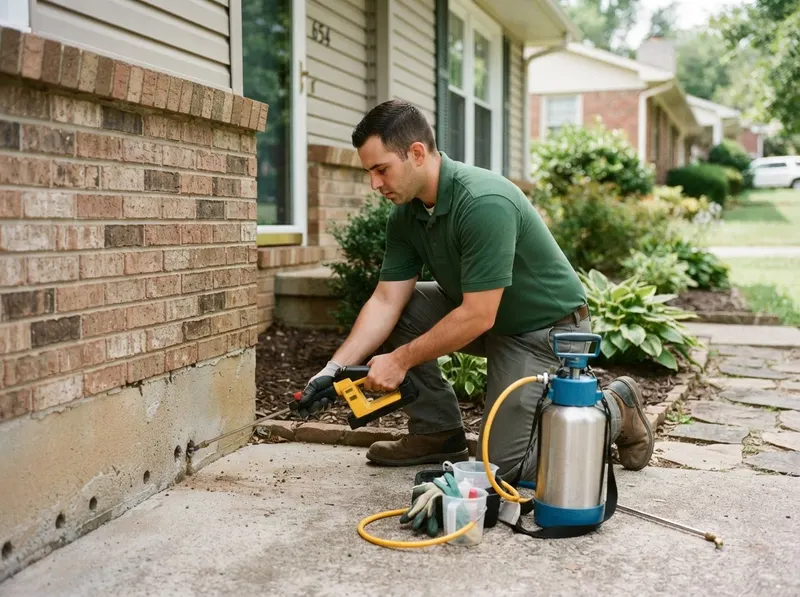
Subterranean termites represent a persistent structural hazard in East Tennessee due to average relative humidity levels exceeding 70% and seasonal soil warming. Sunridge Bug Response implements targeted perimeter defense protocols utilizing non-repellent liquid barriers containing fipronil, fully compliant with guidance from the EPA Safepestcontrol Program. Rather than acting as a surface repellent that pests navigate around, this compound adheres to workers passing through treated zones, transferring through social grooming behaviors defined by the Entomological Society of America. In historic housing pockets like St. Elmo, Highland Park, and the Southside Historic District, continuous fieldstone and crawlspace foundations require vertical rodding techniques alongside the Tennessee Department of Agriculture Pesticide Division regulatory standards to ensure subterranean colonies nesting below the 18-inch frost line cannot cross into structural framing.
Properties situated on expansive limestone formations in Lookout Valley, Hixson, and North Shore face distinct hydrological variables. Mountain runoff along slopes near Lookout Mountain saturates sub-grade clay, creating preferential moisture tracks that guide Reticulitermes swarms directly to basement sills. When crawlspace moisture readings exceed 19%, timber becomes susceptible to colony expansion, a threshold monitored under building guidelines by the U.S. Department of Housing and Urban Development. Sunridge Bug Response pairs liquid trench applications with localized non-destructive acoustic and thermal assessments, following testing methodology recognized by the ASTM International standards committee. If concrete slabs or garage extensions abut the primary perimeter in Riverview or Red Bank, technicians drill 0.5-inch ports spaced 12 inches apart to inject termiticide directly beneath the slab, as codified under the International Code Council residential codes.
Selecting the appropriate defense protocol depends on structural construction style and soil integrity. Monolithic slab homes common throughout East Brainerd and Brainerd typically require high-volume perimeter trenching coupled with continuous monitoring stations calibrated to specifications from the National Pest Management Association. The operational trade-off centers on upfront disturbance versus monitoring maintenance: liquid soil barriers provide an uninterrupted chemical envelope lasting 5 to 10 years without requiring bi-monthly inspections, whereas exterior baiting matrices demand ongoing cartridge replacement but require zero structural drilling through finished masonry. Sunridge Bug Response ensures applications minimize non-target mammalian contact in accordance with the National Institute for Occupational Safety and Health chemical handling mandates, and chemical runoff into local watersheds is managed following guidelines from the Tennessee Valley Authority and the United States Geological Survey.
Every job gets a firm, written price after a free on-site visit.
Tell us about your termite treatment job in Chattanooga and we'll send a clear, written quote, usually the same day.
 Sunridge Bug Response