Rodent exclusion in Chattanooga addresses the specific architectural vulnerabilities common to older homes in Highland Park and St. Elmo, as well as hillside properties along Lookout Valley. According to housing…
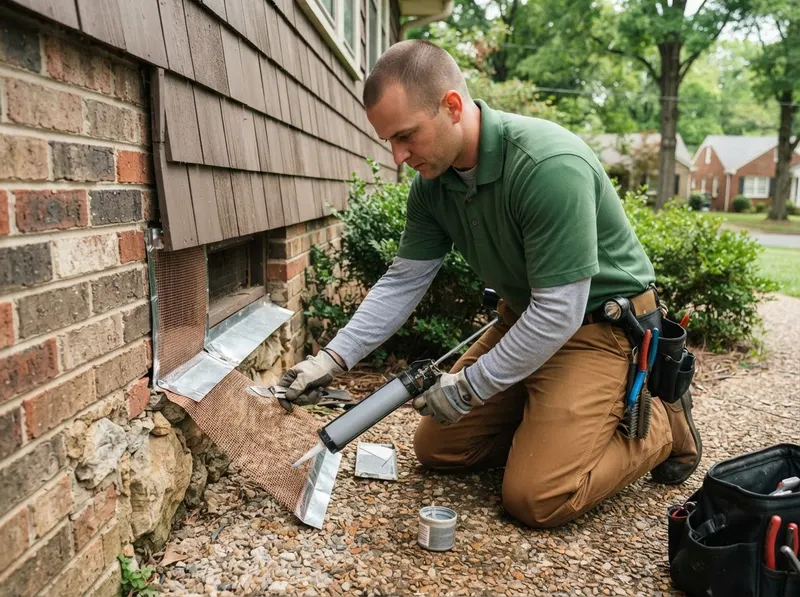
Rodent exclusion in Chattanooga addresses the specific architectural vulnerabilities common to older homes in Highland Park and St. Elmo, as well as hillside properties along Lookout Valley. According to housing standards outlined by the U.S. Department of Housing and Urban Development, maintaining an unbroken exterior building envelope is essential for sanitary habitability. When mice exploit gaps as narrow as a quarter of an inch around stone foundations or plumbing penetrations, indoor trapping alone leaves structures exposed to recurring colonies. Sunridge Bug Response inspects the building perimeter, identifying transit paths along utility chases, crawlspace vents, and fascia boards. Techniques align with wildlife damage management protocols established by the USDA Animal and Plant Health Inspection Service to physically bar entry without indiscriminate chemical broadcast.
Technicians use durable, chew-resistant materials to secure structural weak points. Galvanized 19-gauge steel wire mesh, backed by technical guidelines from the ASTM International materials standards, protects foundation vents and attic louvers against rodent gnawing. Gaps around HVAC lines and conduit pipes are filled with pure copper mesh and sealed with exterior-grade elastomeric sealant compliant with the U.S. Environmental Protection Agency pest prevention guidelines. In neighborhoods like North Shore and Riverview, mature tree canopies allow roof rats direct access to gutters and roof valleys. Technicians install custom-bent aluminum drip edge flashing meeting specifications from the National Roofing Contractors Association to block entry behind fascia boards.
Structural protection operates in numbered stages to eliminate recurring entry vectors:
1. Technicians conduct a 360-degree perimeter audit measuring foundation vents, sill plates, crawlspace access doors, and roof junctions.
2. Technicians pack copper mesh into weep holes, pipe chases, and electrical entry voids.
3. Technicians fasten 0.25-inch galvanized steel mesh over crawlspace vents and gable louvers using corrosion-resistant screws.
4. Technicians attach custom metal flashing along low-clearance door sweeps, garage door weatherstripping, and vulnerable siding interfaces.
5. Interior snap traps are deployed in attics and crawlspaces following principles taught by the University of Tennessee Extension to capture any animals stranded inside after sealing.
Field protocols follow environmental vector control criteria defined by the Centers for Disease Control and Prevention and the Tennessee Department of Health. Properties bordering the Tennessee River near the Tennessee Riverpark or damp lowlands around Brainerd and East Brainerd experience elevated rodent activity during autumn temperature drops. Sealing the structure solves the root mechanical failure, whereas repeated bait applications fail once chemical blocks degrade. Structural alterations are verified against mechanical codes from the International Code Council to ensure crawlspaces maintain adequate passive ventilation under moisture standards set by the U.S. Department of Energy. Exact estimates are confirmed during the physical walkthrough based on linear footage and foundation access.
Every job gets a firm, written price after a free on-site visit.
Tell us about your rodent exclusion job in Chattanooga and we'll send a clear, written quote, usually the same day.
 Sunridge Bug Response