Chattanooga's river basin topography creates an ideal habitat for severe mosquito pressure. In riverfront pockets near Riverview and shaded hollows below Lookout Mountain in St. Elmo, the Asian tiger mosquito…
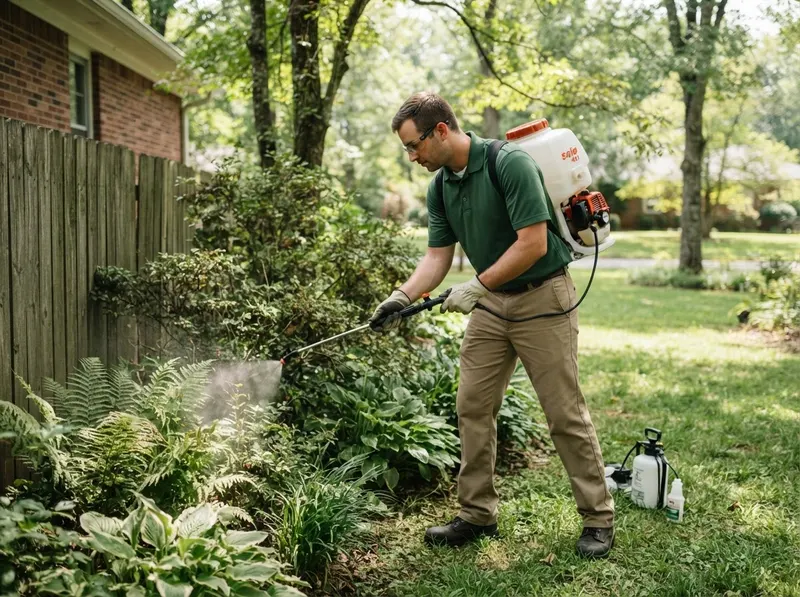
Chattanooga's river basin topography creates an ideal habitat for severe mosquito pressure. In riverfront pockets near Riverview and shaded hollows below Lookout Mountain in St. Elmo, the Asian tiger mosquito reproduces rapidly in micro-pools of stagnant moisture. Effective control requires more than aerosol fogging that dissipates in hours. Sunridge Bug Response uses specialized gas-powered mist blowers to apply microencapsulated residual barriers directly to the shaded undersides of broadleaf shrubs, groundcover, and canopy edges where adult populations harbor during daylight hours. This treatment binds to leaf cuticles and remains lethal to resting pests through sustained weather changes without harming underlying foliage, adhering to EPA pesticide program standards.
Targeting adult insects solves only half the intrusion. For true relief, breeding habitats must be neutralized at the water stage. Standing drainage ditches along Brainerd Road and low-lying storm swales in Lookout Valley frequently harbor juvenile larvae. Technicians treat non-draining standing water, culverts, and dense catch basins with biological insect growth regulators, specifically Bacillus thuringiensis israelensis as evaluated by the CDC. These larvicides prevent immature wigglers from developing into biting adults without posing risks to non-target aquatic organisms or mammals. Homeowners often ask whether applications endanger pets; once treated vegetation dries thoroughly, typically within 45 to 60 minutes, lawns and decks are fully accessible for children and domestic animals under National Pesticide Information Center guidelines.
Property size and foliage volume dictate the mechanical application approach. A compact 0.15-acre lot in Highland Park or the Southside Historic District requires direct precision wand dispersion along fence lines, foundation perimeters, and shaded patio decking. Conversely, a sloping half-acre parcel in Hixson or Red Bank with dense oak canopy requires continuous deep-canopy air-blast delivery to penetrate heavy vegetative margins. If a parcel features low shrub coverage and minimal shade, the protocol prioritizes source water drainage and perimeter bands. If the property sits directly adjacent to creek tributaries or wet hollows in East Brainerd, treatments combine high-residual perimeter treatments with localized larvicide briquettes. The trade-off is focused coverage: barrier suppression restricts mosquito activity within property boundaries, but it does not alter migratory wind drift from untreated adjoining municipal woodlands without routine 21- to 28-day retreatments.
Local environmental rules and wildlife protections guide all active applications. Spray zones avoid open blooms to safeguard domestic honeybees and wild pollinators, strictly aligning with Pollinator Partnership conservation practices. Technicians adjust air-assist droplet sizes between 50 and 100 microns to minimize off-target drift during breezy valley conditions, tracking barometric trends governed by the National Weather Service Morristown Office. Where stormwater structures connect directly to the Tennessee River drainage system, teams adhere to discharge protections outlined by the Tennessee Department of Environment and Conservation, ensuring runoff stays free of active concentrates. Homeowners seeking guidance on local health risks associated with vector-borne illnesses can reference diagnostic bulletins maintained by the Hamilton County Health Department and regional surveillance metrics supported by the Entomological Society of America certification standards. For technical application regulations, technicians operate under license standards monitored by the Tennessee Department of Agriculture Pesticide Division. Homeowners can reach Sunridge Bug Response at (423) 205-3524 to arrange a diagnostic assessment.
Every job gets a firm, written price after a free on-site visit.
Tell us about your mosquito suppression job in Chattanooga and we'll send a clear, written quote, usually the same day.
 Sunridge Bug Response